Tesla's Ex-AI Chief Slams Nvidia's Jensen Huang! What Shocking Truths Are Hidden?

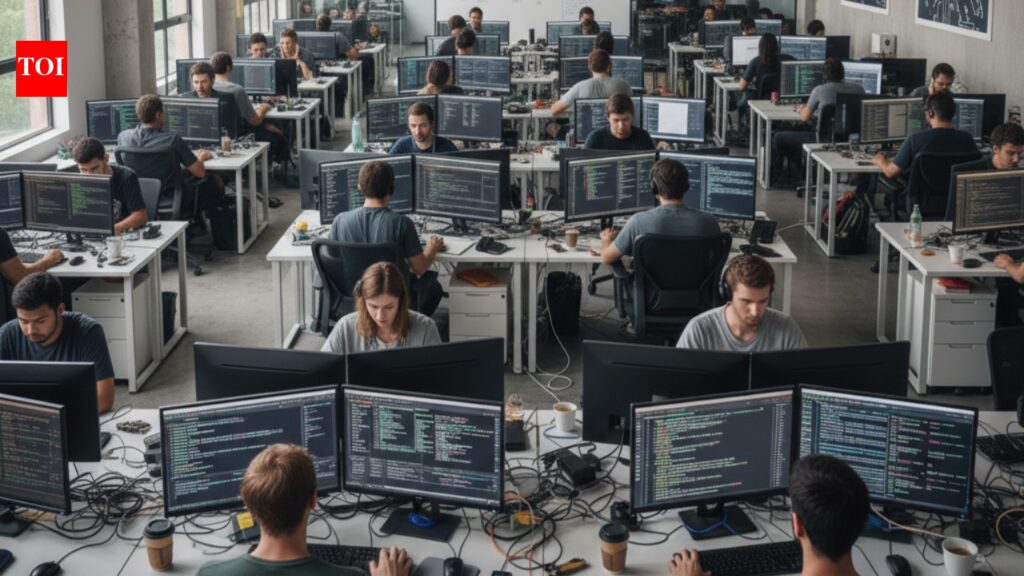
The debate surrounding the role of artificial intelligence (AI) in software engineering has intensified among tech leaders, highlighting a notable divergence in philosophy between figures like Andrej Karpathy, the cofounder of OpenAI and former director of AI at Tesla, and Jensen Huang, the CEO of Nvidia. This division underscores the ongoing discussion about the future of coding in a landscape increasingly dominated by AI technologies.
In a recent post on X, Karpathy expressed his concerns regarding the notion that engineers should abandon traditional coding practices altogether. This contrasts sharply with Huang’s vision for a future where programming is minimized, stating, “Nothing would give me more joy than if none of our engineers were coding at all.” Huang advocates for a paradigm shift where the focus is on problem-solving and innovation, rather than getting bogged down in syntax and programming minutiae.
Huang's perspective aligns with his "Purpose vs. Task" framework, where he posits that coding is merely a task, while the true purpose of engineers lies in discovering and resolving complex problems. At Nvidia, the AI coding assistant Cursor is utilized extensively, with engineers relying on it to streamline their workflows. However, Karpathy's recent experiences tell a different story. In developing his project Nanochat, he found that AI-generated code was often inadequate, requiring him to write everything by hand. He cautions that AI tools can be "fallible, unintelligible, and changing," suggesting that engineers need to remain hands-on to keep pace with technological advancements.
Real-World Challenges with AI in Software Development
This philosophical divide is not just a matter of opinion; it reflects real-world challenges faced by developers today. Michael Truell, the CEO of Cursor, echoed Karpathy's concerns, cautioning developers against placing blind trust in AI tools. He likened this approach to building a house without understanding its plumbing, emphasizing that as more layers are added, the structure may become unstable.
Despite the optimistic projections surrounding AI's ability to enhance productivity, recent research has cast doubt on these claims. A study conducted by METR found that experienced developers using AI assistants experienced a 19% decrease in productivity, contrary to their expectations of a 20% increase. Furthermore, a report from Bain & Company highlighted that productivity gains in programming have been "unremarkable," even as the tech industry has embraced generative AI technologies.
Even within companies that promote AI solutions, leaders acknowledge the limitations of these technologies. Boris Cherny, creator of Anthropic’s Claude Code, remarked that while “vibe coding” can work for temporary projects, it falls short for long-term, maintainable code, which requires careful consideration of each line. Similarly, CEOs like Sundar Pichai of Google have touted impressive figures—claiming that AI can write 30% to 90% of code—but Karpathy’s hands-on experience points to a significant gap between AI-generated code and production-ready solutions.
The contrast in perspectives on the role of AI in software engineering reveals a broader tension within Silicon Valley. As leaders like Huang push for a code-free future, others, like Karpathy, advocate for a more nuanced approach that values traditional coding skills alongside the integration of AI tools. The path forward may require a delicate balance, as engineers grapple with leveraging AI while maintaining the depth of understanding necessary to produce high-quality, maintainable software.
As AI continues to evolve and influence various sectors, the discourse around its impact on software development will remain critical. The future of coding may not lie solely in eliminating syntax but rather in evolving the engineering mindset to harmonize human expertise with AI capabilities.
Is Your Browser Leaving You Vulnerable? 5 Shocking Reasons You Need to Upgrade NOW!
Tech Billionaires Are Hiding a Dark Secret: What AI Utopianism Really Means for You!
You Won’t Believe What MediaTek’s Dimensity 9600 Chip Could Mean for Chinese Smartphones!

HDFC Bank's Shocking New Warning: 98% of Users Don’t Know This APK Trick! Are YOU at Risk?

Is Phillips 66 (PSX) Set for a Shocking Collapse? What Investors Must Know NOW!

Gonzaga's Shocking Victory: How They Defeated Seattle U Without Their Top Scorers! You Won't Believe the Final Score!
You might also like: