
Climate Change Could Make 10 Million Drug-Resistant Infections Inevitable—Are You Prepared?

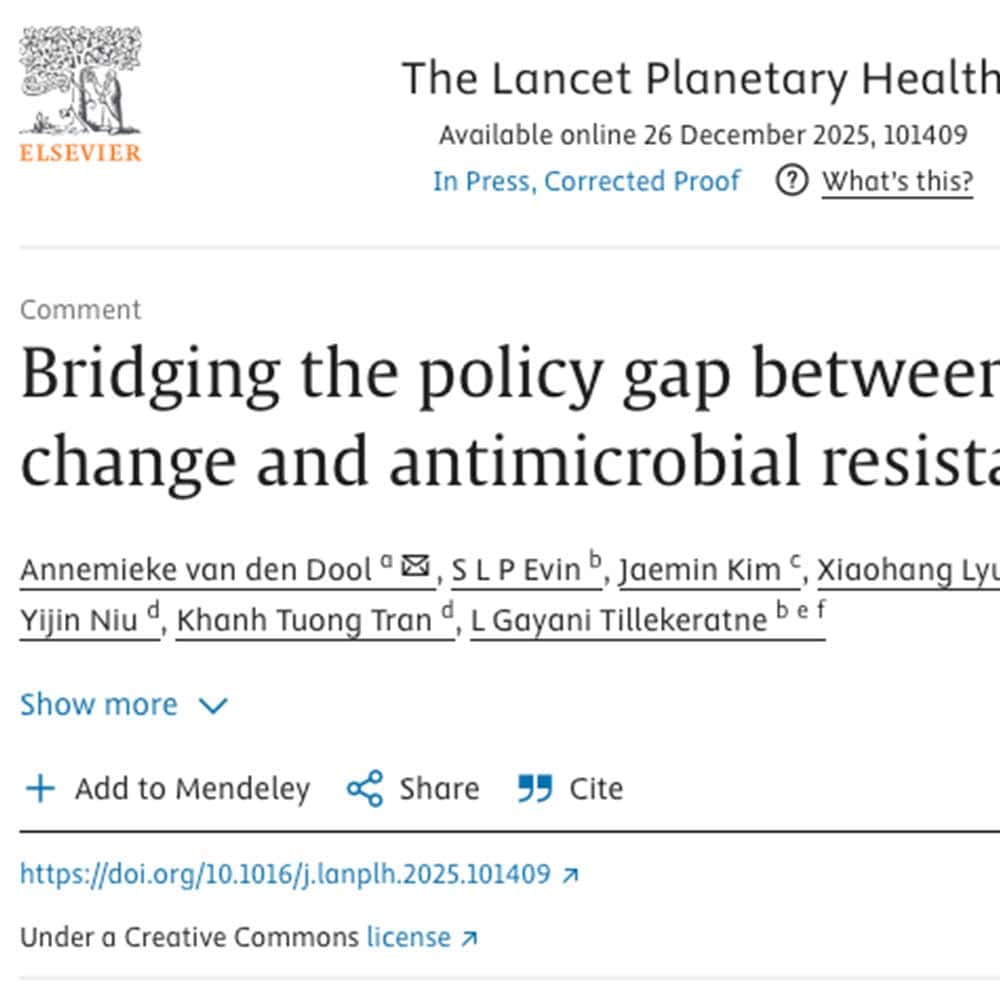
A recent policy commentary published in “The Lancet Planetary Health” by a research team from Duke Kunshan University (DKU) and Duke University sheds light on a critical yet often overlooked connection between climate change and antimicrobial resistance (AMR), both of which pose escalating global public health threats.
Titled “Bridging the Policy Gap Between Climate Change and Antimicrobial Resistance,” the commentary emphasizes that climate factors are conspicuously absent from current AMR policies. This oversight persists despite a growing body of scientific evidence indicating that rising global temperatures and extreme weather events significantly contribute to the proliferation of drug-resistant bacteria. As the world grapples with the consequences of climate change, the ramifications for public health—specifically in relation to AMR—are increasingly dire.
The research team was led by Annemieke van den Dool, assistant professor of environmental policy at DKU, and Gayani Tillekeratne, associate professor of medicine and associate research professor of global health at Duke University. The commentary also included contributions from DKU undergraduates Xiaohang Lyv, Yijin Niu, and Khanh Tuong Tran, as well as SLP Evin from the Duke-Ruhuna Collaborative Research Centre in Sri Lanka, mathematics student Jaemin Kim at Duke University, and Lana Abusalem, an Infectious Disease and Global Health Fellow at Duke University Hospital.
Conducted under the auspices of Duke University’s Bass Connections program—an interdisciplinary initiative designed to tackle complex societal challenges—the research draws on a diverse range of expertise, including global health, medicine, public policy, environmental science, and biology. Van den Dool notes, “Antimicrobial resistance occurs when germs—like bacteria, viruses, fungi, or parasites—stop responding to medicines that used to kill them or stop their growth, such as antibiotics. Because this problem has several different causes, it requires an interdisciplinary approach, which is exactly the strength of both DKU and Duke University Bass Connections.”
AMR is already a significant global health concern, with an estimated 4.95 million deaths worldwide in 2021 associated with drug-resistant infections, including over 1 million deaths directly attributed to AMR. The impact of climate change is expected to exacerbate this crisis by fostering conditions that accelerate bacterial growth, facilitate the spread of resistance genes, and increase antibiotic use, particularly following extreme weather events such as floods and heat waves.
Despite the compelling evidence linking climate change to AMR, the authors argue that climate considerations remain insufficiently addressed in most national and international AMR action plans. This gap is particularly concerning as the world faces unprecedented climate challenges.
The team’s policy recommendations align with the World Health Organization’s forthcoming revised Global Action Plan on AMR. Key proposals include:
- Integrating climate data into AMR surveillance systems.
- Developing predictive models for resistance surges following extreme weather events.
- Strengthening infection prevention and antibiotic stewardship in climate-vulnerable settings.
- Increasing investment in climate-resilient infrastructure and interdisciplinary research.
- Aligning AMR governance with climate adaptation strategies through stronger accountability mechanisms.
Central to the commentary is a call for a “One Health” approach, which recognizes the interconnectedness of human, animal, and environmental health. This approach advocates for enhanced coordination across various sectors and disciplines to address the intertwined challenges of climate change and AMR effectively.
The DKU undergraduate researchers expressed that the project provided invaluable hands-on experience in applying their academic training to real-world policy challenges. For instance, Lyv focused on synthesizing scientific literature and identifying evidence gaps from a public policy perspective, while Tran analyzed and compared regional AMR policies across different countries. Niu examined how flooding and other extreme weather events contribute to the spread of drug-resistant bacteria through mechanisms like wastewater overflow, water pollution, and shifts in community antibiotic use.
Tillekeratne added, “I also find the interdisciplinary and international aspects of this project fascinating and fun. Our research team has generated robust evidence on AMR in South Asia and the U.S., but we have not delved much into policy, which is very important in effecting change. This Bass Connections project has allowed our team to meld the basic sciences, medicine and health, climate science, and policy.”
The implications of this research are profound. As climate change continues to escalate, the interrelationship between our environment and public health underscores the urgent need for integrated strategies to combat AMR. Failure to address these overlapping issues could lead to a public health crisis of unprecedented proportions, placing millions at risk.
2026 Smartphone Prices SURGE Amid Shocking RAM Shortage - Are You Ready for the Impact?

Bitcoin's Shocking Surge: Is $100K Next? Experts Warn: You’ll Regret Ignoring This NOW!

Charlene Choi's Shocking Love Confession: What Her Fitness Trainer Just Revealed Will Blow Your Mind!

Bitcoin's Shocking Double Three Formation: Is a 300% Rally Just Days Away? Don't Miss This!

Portugal's Presidential Election: 3 Shocking Secrets That Could Change Everything—Are You Ready?

Redwood vs. Branson: You Won't Believe What Happened in This 1-1 Draw! Shocking Twist Inside!
You might also like: