
Is Uganda’s President’s Son Plotting a Dangerous Comeback? The Shocking Election Twist You Can’t Miss!

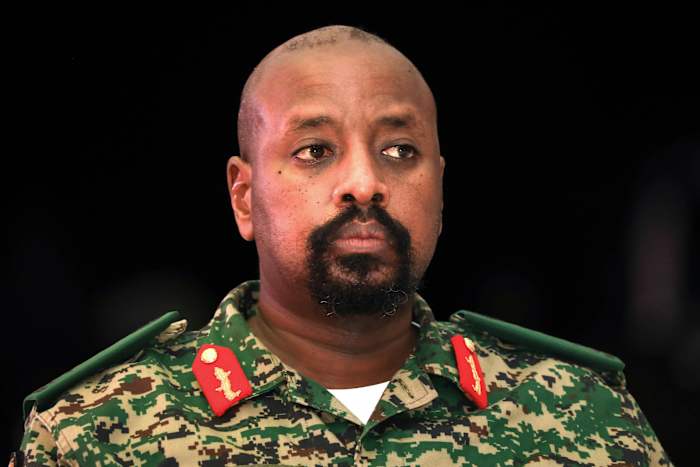
KAMPALA – As Uganda prepares for its elections on Thursday, one figure casts a long shadow despite not being on the ballot: Muhoozi Kainerugaba, the son of President Yoweri Museveni and a four-star general. While Museveni is campaigning for a seventh term, Kainerugaba is viewed as the likely successor, indicative of a potential shift toward hereditary rule in a country long ruled by his father.
Kainerugaba, who has been the chief enforcer of his father's regime, was appointed as the head of the military nearly two years ago after he expressed his readiness to lead. Critics argue that this appointment has effectively put his political ambitions on hold—at least until Museveni decides to step aside. Many Ugandans have now resigned themselves to the idea of **family rule**, a concept the government once vehemently denied, labeling claims of a secret "Muhoozi Project" as false.
In 2023, Kainerugaba made headlines when he directly stated his presidential aspirations, declaring on the social platform **X**, “I will be President of Uganda after my father. Those fighting the truth will be very disappointed.” His growing influence is underscored by the strategic positioning of his allies in top military and security roles, further solidifying his stature as the presumed heir.
Since joining the army in the late 1990s, Kainerugaba's rapid ascent has stirred controversy. In February 2024, just a month prior to his military promotion, President Museveni delegated some of his authority to him, allowing the young general to make high-level military appointments and establish new army departments. Political historian Mwambutsya Ndebesa from Uganda's Makerere University has commented on this unprecedented power, suggesting that Kainerugaba’s authority surpasses that of any military chief before him, which signals a troubling trend toward **hereditary governance** in Uganda.
Ndebesa observed, “Honestly, I don’t see a way out through constitutional means,” indicating that elections appear to be more about legitimizing authority than achieving genuine democratic goals. He noted that any meaningful change would likely emerge from the military's higher echelons rather than from the electoral process.
A personality cult is rapidly forming around Kainerugaba. Public celebrations of his birthday are becoming common, and campaign materials from various parliamentary candidates often feature his emblem. Notably, the Speaker of Parliament, **Anita Among**, referred to Kainerugaba as “God the Son,” highlighting the political weight he carries in a landscape dominated by military influence.
As President Museveni, now 81, shows no signs of retirement, some Ugandans fear the consequences of a turbulent transition. Critics have gone so far as to encourage Kainerugaba to stage a coup against his father to become an opposition hero. **Yusuf Serunkuma**, an academic and political analyst, wrote in the local **Observer** that the younger Kainerugaba's failure to distance himself from nepotism reflects poorly on his potential leadership.
Supporters of Kainerugaba, however, paint a different picture. They describe him as humble and critical of the rampant corruption that has plagued Museveni's government, suggesting he may offer a peaceful transition of power—a significant milestone for a nation that has not experienced one since gaining independence from British colonial rule in 1962.
While opposition leaders like **Bobi Wine**, a prominent presidential candidate, allege that Kainerugaba's military has taken control of the electoral process, they cite instances of violence against their supporters. An Amnesty International report highlighted a brutal crackdown by security forces, including a November incident where a man was killed during a rally for Wine’s party, the **National Unity Platform**.
Defending Kainerugaba, **Frank Gashumba**, a vice chairman of the Patriotic League of Uganda, dismissed claims from Wine as exaggerated, stating, “Nobody is touching him. He’s lacking the limelight.”
Aside from Wine, there has been little public dissent within Museveni's party regarding the notion of hereditary leadership. However, one figure, **Kahinda Otafiire**, a retired major general and Uganda's interior minister, has publicly urged Kainerugaba to pursue leadership based on merit rather than lineage. He warned that perpetuating a family dynasty could erode the essence of democracy for which they once fought.
Otafiire remarked, “Let there be fair competition, including Gen. Muhoozi. Let him prove to Ugandans that he is capable, not as Museveni’s son but as he, Muhoozi, who is competent to manage the country.”
As the country gears up for the elections, the political landscape remains fraught with tension and uncertainty. With Kainerugaba's ambitions intertwined with his father's enduring grip on power, many Ugandans are left to wonder what the future holds for their democratic aspirations.
Wiggins' 40-Point Exploit Wasted: How Miami Blew a Golden Chance Against the Thunder!

You Won't Believe How Much Realestate.com.au Just Paid to Partner with the Australian Open!

Shocking Climate Change Facts: MISO Outages Leave Millions in the Dark—Are You Prepared?

Is Anthropic's New Healthcare Push the Game-Changer Patients Desperately Need? 5 Shocking Revelations!

India's Shocking Move: Will Smartphone Giants Reveal Secret Source Codes? What This Means for YOU!
Nikki Glaser’s Shocking Awards Show Entrance: You Won't Believe What Happened Next!
You might also like: