
Is Your Favorite College Team Selling Out? The Shocking Truth Behind Sports' New Commercial Frontier!

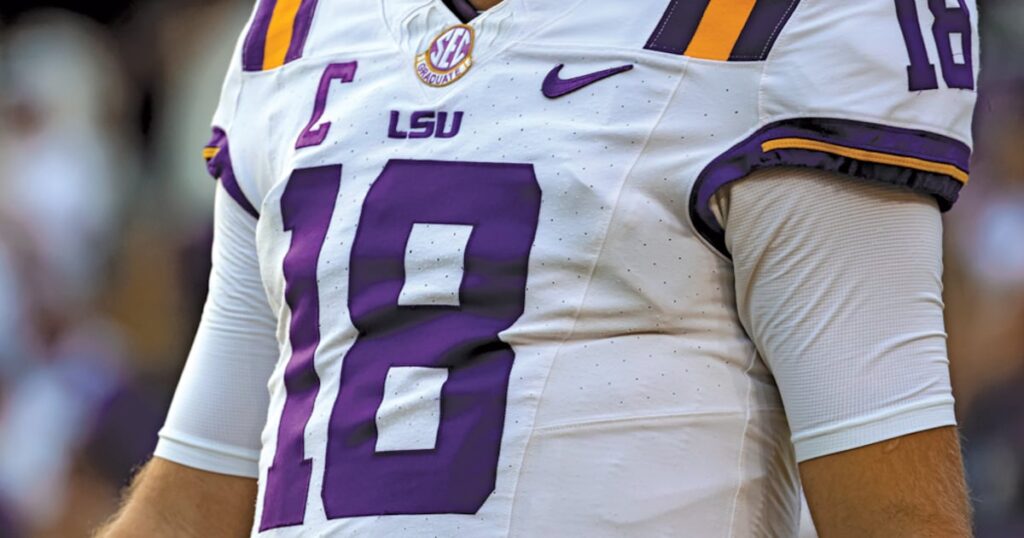
As college athletics continue to evolve, so too do the revenue streams that support them. Recently, Louisiana State University (LSU) took a bold step into uncharted territory by becoming the first school in the United States to sell a commercial jersey patch. This move not only sets a precedent but also illustrates the ongoing transformation within college sports amidst increasing financial pressures.
LSU’s equipment staff, well-versed in affixing specialty logos, was tasked with a sensitive mission last year. The athletic department's business operations needed two sets of jerseys across football, basketball, and baseball, each sporting a new patch reflecting potential corporate sponsors. This proactive strategy aims to capitalize on a market that could be worth millions, even before the NCAA officially approves the use of commercial patches.
“[We] created and made with those patches on there just so we could get a real-life effect of it,” said Clay Harris, LSU's deputy athletic director and chief revenue officer, who spearheaded this groundbreaking initiative. By August, the school had finalized a multimillion-dollar deal with Woodside Energy, an Australian oil and gas company, marking a significant milestone in college sports marketing. Although the specifics of the deal remain private, it clearly demonstrates the lucrative potential of jersey patches.
While jersey patches for college athletics are not yet permitted, many in the industry are operating under the assumption of "when," not "if," they will become a reality. Discussions regarding this matter were slated for the NCAA’s Division I Cabinet at its convention in Washington, D.C. This environment of uncertainty has inspired LSU to act swiftly, utilizing a first-mover advantage to establish relationships with corporate sponsors before formal regulations are in place.
Tim Pernetti, commissioner of the American Conference, emphasized the shift in mindset regarding revenue generation within college sports. “The current climate,” he noted, “given the demands on athletics departments, the way things are changing under our feet on almost a daily basis ... has everyone’s heads turning very quickly on this.” The landscape of college athletics has evolved significantly, as financial needs intensify. The cap laid out in the House settlement, amounting to $20.5 million, has created competitive table stakes, making jersey patches an attractive option for schools seeking additional funding.
The NCAA has historically been conservative in its approach to commercializing college athletics. However, there is growing momentum for change. Arkansas AD Hunter Yurachek remarked on the potential value of jersey patches, citing the significant exposure that comes with high-profile events like SEC football games and March Madness. “When you think about the SEC exposure that we get ... there is a significant, seven-plus-figure value for having logos on jerseys,” he stated.
The NCAA is expected to discuss the possibility of allowing commercial patches for the 2026-27 season. While no vote is currently scheduled, committees have been actively examining the size, location, and number of logos permitted on uniforms. Research from Learfield and Wasserman suggests that college football and men’s basketball patches could be valued between $500,000 and $12 million annually, depending on various factors such as brand strength and market size.
As the landscape of college sports shifts, schools are also exploring how to balance modernization with the traditions that fans cherish. Current NCAA rules have allowed for the approval of corporate logos on 25-yard lines starting in 2024, with approximately 67% of Power Four schools incorporating sponsor logos onto their playing surfaces. Mississippi State AD Zac Selmon noted that fans have largely accepted these changes, provided the logos are tastefully integrated. "If you put something on there that just looks bad, you could get some pushback," he explained.
Despite the potential benefits, selling jersey patches poses challenges, particularly regarding existing apparel contracts that often grant major companies like Nike, Adidas, and Under Armour exclusivity over uniforms. ACC Commissioner Jim Phillips emphasized the importance of considering the perspectives of these apparel partners as schools navigate the evolving landscape of sponsorship opportunities.
Furthermore, while the NCAA proposal currently allows for regular-season patches, it would not extend to postseason play, a significant limitation given that March Madness draws tens of millions of viewers annually. This decision could affect the perceived value of jersey patches during high-stakes games.
In conclusion, as more schools like LSU explore commercial opportunities through jersey patches, they stand at the forefront of a potential new revenue stream in college athletics. This evolving trend could reshape the financial landscape of college sports, driving increased funding and resources for athletic programs while balancing the need to maintain a connection to tradition.
Is Japan on the Brink? Coalition Leader Drops Bombshell Hint at Snap Election—What’s Next?

Gmail’s Shocking New Feature: You Won’t Believe What Google AI CEO Just Revealed!

G20 Leaders Promised Stability—Now They’re Ignoring Climate Crisis and Debt! What’s Next?
India's Shocking Plan: Will Smartphone Makers Be Forced to Hand Over Secrets? You Won't Believe the Fallout!

You Won't Believe How the Bulls Shocked the Mavericks with a 125-107 Stunner – Find Out the Game-Changing Moment!

Disney’s Shocking Move: Why Their 2% Stake in Webtoon Could Change Everything—Are You Ready?
You might also like: