
Stanford PhD Dropouts Under 30: How Carina Hong and Demi Guo Are Disrupting Tech—And Why You Need to Know Now!

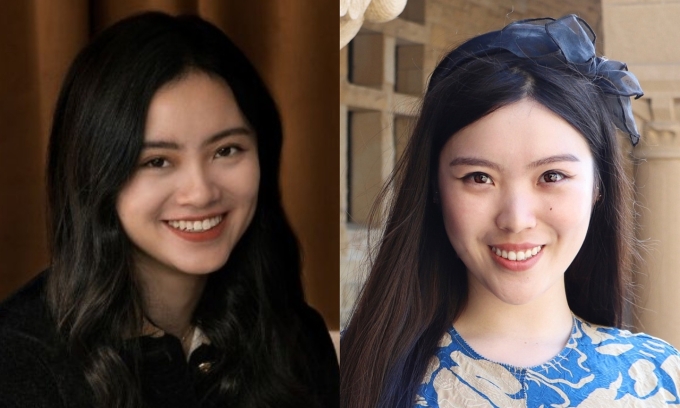
In the rapidly evolving world of technology and artificial intelligence, two young entrepreneurs, Carina Hong and Demi Guo, are making significant strides with their innovative startups. Both women left prestigious PhD programs at Stanford University to pursue their visions, bolstered by impressive educational backgrounds and early achievements in their respective fields.
Carina Hong, now 24, founded Axiom Math in March 2023, a company focused on developing an "AI mathematician." This startup aims to tackle complex mathematical problems, create detailed proofs, and validate its own reasoning—an ambitious endeavor that seeks to position AI at the forefront of mathematical exploration. In September 2023, Axiom Math secured a remarkable $64 million in seed funding and has attracted talent from major tech firms, including Meta and Google DeepMind. Hong's team also includes renowned mathematician Ken Ono, which underscores the startup's commitment to excellence.
Demi Guo, 27, co-founded Pika in 2023, a startup that specializes in AI-driven short video creation. By October 2023, Pika had already gathered 16.4 million users and raised approximately $135 million, resulting in a valuation of $470 million. The rapid growth of Pika showcases the increasing demand for innovative content creation tools powered by AI, and Guo's vision is to enhance the creative process rather than replace human artists.
From Academia to Entrepreneurship
Both entrepreneurs made the bold decision to leave their PhD studies at Stanford to focus on their startups. Hong was pursuing a joint law degree and a mathematics PhD but stepped away shortly after Axiom Math's seed funding. Her academic accomplishments include a bachelor’s degree in mathematics and physics from the Massachusetts Institute of Technology (MIT), where she authored nine research papers and completed 20 advanced mathematics courses. Additionally, she was a Rhodes Scholar at Oxford, studying neuroscience and producing two dissertations. Reflecting on her academic journey, Hong has stated that she found both mathematical research and law school "very fun."
Guo, likewise, departed from her computer science PhD program, along with co-founder Chenlin Meng. Her background in AI and content creation, combined with frustrations from trying to make a short film, led to the inception of Pika. Guo also holds a bachelor’s degree in mathematics and a master’s in computer science from Harvard University. Looking back, she emphasized that personal growth, rather than the prestige of her institutions, defines her educational experience.
Both women hail from China—Hong from Guangzhou and Guo from Hangzhou. Their early academic achievements were notable, with Hong showcasing her prowess in mathematics competitions and receiving the Schafer Prize in 2022 and the Morgan Prize in 2023. Guo distinguished herself with a silver medal at the International Olympiad in Informatics in 2015. Their impressive records are testament to their capabilities in fields that have often been male-dominated.
While Guo grew up in Silicon Valley, benefiting from a family background that included an MIT graduate mother and a father who led a technology company, Hong's roots are more modest. She has shared that she is one of the few in her large extended family to receive a college education.
Recently, both women were recognized on Forbes’ 30 Under 30 lists for their contributions to AI. Guo and Pika made the 2025 list, while Hong was celebrated in the 2026 cohort. Their innovations come at a time when AI's impact on various industries, particularly creative fields, is a hot topic of discussion.
For Axiom Math, Hong’s vision is groundbreaking. She asserts, "Math is the perfect sandbox for building superintelligence," underscoring her belief in the powerful role mathematics can play in AI development. Meanwhile, Guo’s mission with Pika, as she stated, is to "build the best video model" while ensuring that the technology serves creators, not replaces them. "The human artist is the one to guide AI in the right direction and eventually become a masterpiece," she emphasized.
As Axiom Math and Pika continue to grow, both companies represent a new wave of innovation driven by young minds eager to reshape their industries. Their journeys illustrate the potential for technology to enhance human creativity and problem-solving capabilities, marking a significant moment in the evolution of AI and its applications.
You Won't Believe These 8 "Luxury" Brands Are Actually Middle-Class Fakes – Find Out Why!

This Mind-Blowing Cyberdeck Turns Your Old Smartphone Into a $1,000 Tech Marvel—Find Out How!

Shocking Revelations: What the Apalachee High School Shooter's Mental Health Exam Could Uncover!

Why Fans Are Calling Christmas' Spurs vs. Thunder Showdown the NBA's Most Explosive Rivalry!

You Won’t Believe the SHOCKING Reason I’m Quitting Marriage Posts Forever!

You Won't Believe What Happened at Little Jamaica's Wild Open Mic Night – Shocking Performances That Left Everyone Speechless!
You might also like: